
The THRIVE Health Equity Framework™
A Strengths-Based Framework for Completing the Health Equity Paradigm.
Current health equity frameworks focus on health disparities, either naming them or developing strategies to mitigate risk and reduce systemic barriers. Both practices, as important as they are, share a significant limitation. They lack an acknowledgement of the underappreciated strengths and resiliences in historically excluded communities. Without documenting strengths and resiliences across all domains and population groups, we cannot understand how best to nurture and protect the resources and conditions that allow for these capacities. As such, our work can perpetuate deficit framing and harmful narratives of risk affinity towards the communities we aim to serve. That imbalance of documenting only community deficits without also capturing community strengths shapes every funding decision, every program design, and every accountability structure. In general, this gap exists across the health equity field, and the THRIVE Framework was developed to address it. Grounded in Dr. Brown's published resilience work and extending that body of work into a six-component operational framework, THRIVE gives foundations, health systems, and community organizations the structural architecture they need to move from sophisticated documentation of harm into the practice of structural health equity transformation that centers community strength, dignity, and full humanity.
The THRIVE Framework extends the published work of Dr. LaVerne L. Brown, who led the conceptualization, development, and implementation of the NIH Resilience Framework. Positioned as an offspring to the NIH Resilience Framework, THRIVE is an operational framework for structural health equity transformation.
Organizations that engage with THRIVE today are participating in the early application of a rigorously developed framework with published research roots, and their engagement contributes directly to growing the body of evidence that documents what becomes possible when health equity practice is built on a more complete knowledge of the communities it serves.
The THRIVE Framework™ Architecture
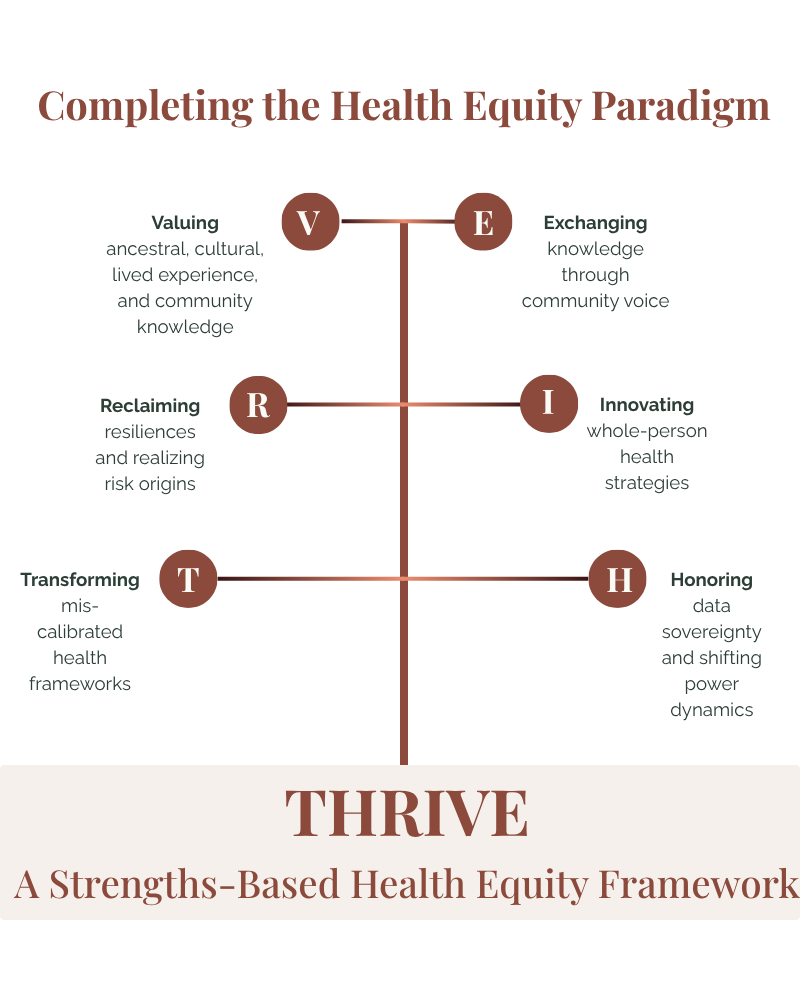
The THRIVE Health Equity Framework: six interconnected principles that together build the complete architecture for structural health equity transformation.
The THRIVE Framework™ Principles
The six THRIVE principles form a complete framework architecture. Organizations engaging THRIVE identify the principles that speak most directly to their immediate institutional challenges and build from there, deepening and expanding their engagement across additional components as their practice develops. Component-level entry is not a partial adoption of THRIVE. It is how transformative framework engagement begins.
-
Health disparity measurement and health equity frameworks are only as accurate as the frameworks, screening tools, and measurement instruments on which they are built. Transforming mis-calibrated frameworks does not mean discarding rigorous measurement practice. It means examining the foundations of our health systems honestly; asking which populations were included in knowledge creation, whose knowledge was treated as expertise versus supplemental data during study designs, and how accurately do the implied outcomes represent the communities who are being assessed or served.
A precise example of mis-calibrated health frameworks lives inside Dr. Brown's own published work describing the Vitamin D Paradox in Black Americans. Dr. Brown’s work points to the standard vitamin D reference ranges that established sufficient vs. insufficient vs. deficient vitamin D levels for maintaining bone health. Despite the inadequate representation of Black Americans in the referenced studies, the vitamin D ranges were applied universally, prompting a distorted clinical picture of widespread vitamin D deficiency in Black communities. The framework essentially pathologized what a more complete understanding of vitamin D would reveal as a normal physiological variation. This mis-calibration carries direct clinical consequences, and it operates across health frameworks at every level of the health equity ecosystem.
What Transformation Requires in Practice
1. Organizations audit the frameworks they currently use for population origin and calibration accuracy. 2. Organizations build formal processes for recalibrating mis-calibrated tools in genuine partnership with the communities those tools are meant to serve, treating community members as primary knowledge holders rather than as research subjects or program beneficiaries. 3. Organizations embed community accountability structures with real decision-making authority into their framework governance so that recalibration is not a one-time correction but an ongoing institutional practice.
-
Data sovereignty determines who has the authority to determine which knowledge is valued, how it is collected and measured, how outcomes are interpreted, who benefits from the knowledge, and what decisions it drives. In our current data ecosystem, communities carrying the greatest burden of health inequity have the least power over the information that describes their lives, their bodies, and their environments. Honoring community data sovereignty requires a structural redistribution of decision-making power embedded in organizational governance, funding agreements, and program accountability structures.
What Honoring Sovereignty Requires in Practice
1. Organizations audit their current data governance structures and name where decision-making authority sits and where it does not. 2. Organizations build community data sovereignty agreements that give impacted communities formal authority over data collection design, interpretation, access, and use. 3. Organizations restructure funding and accountability agreements to reflect community governing authority rather than community advisory input, treating sovereignty not as a program feature but as a foundational governance requirement.
-
This gap begins with how resilience is defined.
Resilience is the capacity to respond to a challenge in ways that produce beneficial health outcomes. This definition requires a challenge to be present and documented before resilience can be measured. That requirement makes the structural conditions producing the challenge visible, necessary to name, and impossible to treat as neutral background. It also makes it scientifically indefensible to not ascertain the strengths and resiliences in all communities. Risk identification without strengths identification is incomplete research that produces an incomplete and distorted understanding.
This standard was made explicit in Dr. Brown's NIH Resilience Framework work, which (alongside risk identification) required partners to identify, document, and develop strategies to nurture resilience and strengths across all domains, including biological, psychological, social, and structural. This was not established as a programmatic preference. It is a methodological requirement rooted in scientific precision.
Communities deserve honest, unflinching naming of the fact that current systems can deplete resiliences over time. No community's resilience is infinite when the structural conditions producing the challenges are never addressed. Resilience depletion is not a community failing. It is a systems accountability crisis that health equity funders and practitioners must name and address directly.
What Reclamation Requires in Practice
1. Organizations replace coping-based resilience definitions with challenge-responsive resilience definitions across all programs, measurement systems, and evaluation frameworks (noting that coping-based resilience definitions render a community's survival as evidence that the burden is manageable rather than evidence that the burden is unjust). 2. Organizations build systematic strengths identification processes that document community strengths across biological, psychological, social, cultural, and structural domains, treating those strengths as the primary foundation for program design rather than as supplementary context. 3. Organizations complement resilience and strengths assessments with honest risk origin analysis that traces health risks to their structural, historical, and political roots rather than stopping at behavioral or biological descriptors.
-
THRIVE defines whole-person health across two distinct constructs that must operate together for innovation to produce structural health equity transformation.
The first construct is domains. The six domains of whole-person health are environmental, community, social, behavioral, biological, and physiological. These are the territories of human life and experience across which both risks and resiliences must be documented with equal rigor before any health strategy is designed. These domains are aligned with the NIH Resilience Framework, which established as a methodological requirement that risks and resiliences must be identified and documented across all domains simultaneously. Carrying that requirement into health strategy innovation means that an organization cannot claim to be innovating whole-person health strategies if its understanding of any single domain is built only on risk data. The resiliences, strengths, and protective capacities present in each domain are not supplementary findings. They are the design foundation.
The second construct is dimensions. The four dimensions of health systems practice are health care, health science and research, programs, and policies. These are the institutional and structural arenas through which health systems act on communities. Domains tell organizations where to look. Dimensions tell organizations where to act. Whole-person health innovation requires organizations to look across all six domains simultaneously and act across all four dimensions simultaneously, designing health care, research, programmatic, and policy responses that reflect the complete picture of risks and resiliences those domains produce.
The relationship between domains and dimensions is where innovation lives in the THRIVE framework. Structural health equity transformation requires that all four dimensions speak to each other, that they are all informed by the same complete domain-level understanding of risks and resiliences, and that communities have governing authority over how that understanding shapes innovation across every dimension.
What Innovation Requires in Practice
1. Organizations audit their current health strategies for both domain completeness and dimensional completeness. Domain completeness asks whether the organization's understanding of each of the six domains, environmental, community, social, behavioral, biological, and physiological, includes documented strengths and resiliences alongside documented risks. Dimensional completeness asks whether the organization's innovation is operating across all four dimensions, health care, health science and research, programs, and policies, in a connected and coherent way rather than as isolated efforts.
2. Where domain gaps exist, organizations build systematic strengths and resilience identification processes that complete the picture before new strategies are designed. 3. Where dimensional gaps exist, organizations build cross-dimensional innovation processes that connect health care, research, programmatic, and policy work within a single coherent framework. 4. Across both constructs, organizations establish community governing authority over innovation design and evaluation, ensuring that the communities whose lives are described by domain-level data have decision-making power over the dimensional strategies those data are used to justify.
-
The health equity field has begun to accept a significant scientific truth: trauma transmits across generations. Through biological mechanisms including stress-response dysregulation and immune-inflammatory signaling, and through relational mechanisms including caregiving patterns, psychosocial environments, and the transmission of survival-oriented behaviors, the health consequences of structural harm do not stop at the generation that experienced the original injury. They travel forward.
That acceptance represents a meaningful expansion of the intergenerational health frame. What it has not yet done is apply the same scientific standard symmetrically.
If trauma transmits across generations through biological and relational mechanisms, so do protective factors, strengths, and resiliences. Protective biological and relational information are carried forward through the same mechanisms the trauma literature is now mapping for harm. The field's decision to study intergenerational trauma transmission with rigor while leaving intergenerational resilience transmission largely uninvestigated is not a neutral scientific gap. It is deficit framing operating at the research design level, producing a growing science of intergenerational harm without a corresponding science of intergenerational protection.
Valuing ancestral, cultural, and community knowledge in the THRIVE framework is therefore not only a knowledge corrective, it is a scientific corrective to an asymmetric intergenerational health research agenda that has mapped inherited harm without mapping inherited protection with equivalent rigor. Both corrections are necessary. Neither is sufficient without the other.
What Valuing Knowledge Requires in Practice
1. Organizations audit their current research and program design processes and name whether intergenerational resilience is being documented alongside intergenerational risk. 2. Where that documentation is absent, organizations build systematic processes for identifying, recording, and building on the protective factors, strengths, and resiliences that communities carry across generations through ancestral knowledge, cultural practice, and relational tradition.
3. Organizations bring community elders, cultural practitioners, and ancestral knowledge holders into research design and program development as primary experts whose knowledge of intergenerational resilience is treated as methodologically valid evidence, not as community narrative that supplements institutional data. 4. Organizations advocate within their fields and funding relationships for research investment in intergenerational resilience transmission that matches the investment currently directed toward intergenerational trauma, naming the current asymmetry explicitly as a consequence of deficit framing at the research design level and not as a neutral reflection of scientific priority.
-
Genuine knowledge exchange is circulatory. It moves in three directions simultaneously and all three directions must be active, resourced, and valued for exchange to be real.
The first direction is knowledge moving toward communities. Researchers, health systems, funders, and policy makers hold knowledge that communities have a right to receive in forms they can fully access, evaluate, and act on with agency and understanding. Data reports, clinical language, and policy documents are not accessible knowledge exchange vehicles for most communities. Storytelling, the arts, and community-led narrative are the primary translation vehicles through which institutional knowledge becomes genuinely accessible, not as a simplification of complex information but as a transformation of it into forms that honor how communities actually process, discuss, and integrate knowledge about their own health.
The second direction is knowledge moving within communities. Storytelling, the arts, and community-led narrative are the primary vehicles through which health knowledge circulates laterally inside communities, between generations, between neighborhoods, between cultural groups, and between lived experience holders. This is the intra-community and intergenerational knowledge exchange that has sustained ancestral health wisdom, cultural protective practices, and collective resilience across generations. This directional flow connects E directly to V. The relational transmission mechanism through which intergenerational resilience and risk travel across generations is precisely the storytelling, arts practice, and community narrative that this component names as primary health equity practice vehicles.
The third direction is knowledge moving from communities back to researchers, health systems, funders, and policy makers. This is the direction most health equity institutions believe they are already honoring through community engagement processes, advisory boards, and needs assessments. What those processes almost universally fail to do is treat community knowledge as primary evidence that changes institutional decisions rather than as contextual input that informs decisions institutions have already made. When storytelling, the arts, and community-led narrative are positioned as primary evidence vehicles rather than as communication strategies, the knowledge communities carry about their own health, their own resilience, their own risk origins, and their own visions for transformation becomes the research finding, the policy driver, and the program design foundation. That repositioning is not a communication preference. It is a power transfer.
The complete knowledge exchange circuit that E describes requires all three directional flows to function simultaneously. When knowledge moves only from institutions to communities, it is information delivery. When knowledge moves only from communities to institutions, it is data extraction. When knowledge moves only within communities without connection to institutional decision-making, it is cultural preservation without structural impact, which is valuable and insufficient for health equity transformation. THRIVE holds all three flows as equally necessary, equally resourceable, and equally non-negotiable in any health equity practice that is built on genuine community partnership.
What Exchanging Knowledge Requires in Practice
1. Organizations audit their current knowledge exchange practices across all three directional flows and name which directions are currently active and which are not. That audit must ask three specific questions. First, are we translating institutional knowledge into forms communities can genuinely access, evaluate, and act on, and are we using storytelling, the arts, and community-led narrative as the primary translation vehicles rather than simplified data reports. Second, are we resourcing the intra-community and intergenerational knowledge exchange that moves health knowledge laterally within communities, and are we treating that exchange as a health equity practice infrastructure rather than as a cultural program. Third, are we treating the knowledge communities generate through storytelling, arts practice, and community-led narrative as primary evidence that changes our research designs, our policy positions, and our program architectures, rather than as community input that contextualizes decisions we have already made.
2. Organizations resource all three directional flows with equivalent seriousness. That means allocating dedicated funding for community-to-institution knowledge translation, for intra-community knowledge exchange infrastructure, and for institutional processes that integrate community-generated knowledge as primary evidence. It means building storytelling, arts-based practice, and community narrative into research design, program evaluation, and policy development as formal methodological must build institutional accountability structures that measure knowledge exchange in all three directions, not only the direction that produces data for institutional use. A health equity institution that can measure how much community knowledge it has collected but cannot measure how much institutional knowledge it has translated into genuinely accessible community forms, or how much it has invested in the intra-community knowledge exchange infrastructure that communities depend on, has not yet built a knowledge exchange practice. It has built a more sophisticated knowledge extraction practice and named it partnership.
THRIVE Transforms the Health Equity Paradigm
For decades, health systems have generated sophisticated and extensive data on risks, deficits, and disease burden in historically excluded communities, and have built interventions, policies, and funding priorities almost entirely from that data. What has been missing is an equally rigorous, equally systematic capture of the strengths, resiliences, and protective factors that exist in those same communities and that any complete understanding of health outcomes requires. THRIVE insists on both. It does not supplement the deficit framework with a strengths-based addendum. It restructures the paradigm so that strengths, resiliences, and protective factors are captured with the same institutional seriousness and the same methodological rigor as risks and deficits, because a framework that captures only what goes wrong can only ever produce interventions designed to stop what is going wrong. It cannot produce the partnerships, the policies, or the systems architecture that communities actually need to thrive.
THRIVE provides something no isolated domain framework can provide: the context for interconnectedness. Health outcomes do not live inside a single domain. They are produced at the intersection of biology, environment, culture, policy, community knowledge, and lived experience simultaneously. THRIVE holds all of those dimensions together as an integrated system rather than as parallel silos, which is what makes it possible to understand communities as whole and complex rather than as collections of risk factors to be managed. That completeness is what makes genuine partnership possible. And genuine partnership, built on a complete and strengths-informed understanding of the communities health systems aim to serve, is the only foundation from which transformative and lasting health equity can be built.